
So after Hiroshima, Kristen, Andrew and I temporarily parted ways due to my having to attend the JET Recontracting Conference in Kobe. I was sort of dreading it because I was having a lot of fun with K and A and didn't want to leave them, but the conference ended up being a lot of fun and really helpful too.
First off we stayed at a really beautiful hotel. Kobe Portopia Hotel is on a manmade island right off Kobe (but still part of it) and WOW I have never stayed at a hotel so nice. The lobby had beautiful chandeliers and stained glass ceilings, and my room was enormous, with nice beds and even a couch. The hotel was sort of in a weird location though, it was completely deserted in the day and in the evening, I think development of this manmade island is still in progress. Usually I don't have to walk more than a block to find a convenience store, but here it took a while to find one. Anyway, Day 1 of the conference was relatively mellow, with an opening ceremony, an explanation of the Japanese education system by a Japanese fellow from the government who spoke English with a French accent (strange, believe me...), and then a couple of workshops that must not have been that helpful or important because I can't remember them.

Vanessa, Suzy, and Nolan at one of our workshops.

Me and Anna, hot in glasses!
Of course most of the fun happened after hours. A bunch of people were going to go eat Kobe beef (called Kobe-gyu in Japanese) and I decided to tag along. I knew it would be expensive, but the fact that everyone I told that I was going to Kobe asked me right off the bat, "Oh, are you going to eat Kobe beef?" meant that perhaps if nothing else I should, well, eat Kobe beef. Suzy had a list of restaurants from the hotel and I recognized one from the Lonely Planet that was affordable but delicious so we headed there, Kobe A-1 Steakhouse. And I will fully admit that it was everything I dreamed of and more. Sure, it was 6500 yen (about $65) for a small slab of steak, salad, vegetables, rice, and a glass of wine, but it was worth it. The beef was soft and tender and melted in your mouth. My teeth went right through it, minimal chewing required. Silence fell upon the table as we savoured the meat, some with eyes closed...okay, maybe just me. I can focus on the flavor better that way!!

The chefs cooking up our beef.

That's 6500 yen meat you're looking at right there.

Close up. It was SO GOOD. (My mom said it BETTER have been good for 6500 yen!)

Me and The Beef
Afterwards, most of the ALTs went out on the town to various recommended watering holes. It was nice to hang out with a lot of people I don't usually hang out with and meet a lot of new people too. I had a good time, though I don't quite remember how we ended up at karaoke...

Sannoymiya-dori in the downtown area of Kobe.

Karaoke-ing
A lot of people told me that Kobe is a nice city to live in and hang out in, but it's not like other big cities, where usually there is something to see. The main pull of Kobe is its multitude of cool bars, cafes, and restaurants. I'll agree with that; it was a cool city. It has a very international feel to it (since it was rebuild after the earthquake, it looks like any modern city), and you can get a lot of different kinds of food there. I have been telling everyone that it reminds of San Francisco, sort of, since it's by the water and there's a lot of good places to eat and drink.
Day 2 of the conference started off nicely with a great presentation talking about Japanese and Western (for lack of a better word...) work ethics and how these differences affect the way we work and communicate with our Japanese counterparts. For example, in the West, frankness is a virtue; we like it when people are direct and speak their minds. However, in Japan, this is often seen as a sign of insensitivity. The rest of the day was spent in seminar with ALTs of similar job situations (elementary, junior high school, high school) and was admittedly excruciatingly slow and tedious. It was a 3 hour stretch and so difficult to get through, despite the fact that I consider myself to have a relatively patient and enduring composure in such situations. (That means it was really that bad..).
That evening, we decided to tone the fun down a little bit and go do some sighto-seeing. A group of us headed out to Harborland, which is a small area by the water that has nice shops and restaurants and a little amusement park with a huge ferris wheel. We rode the ferris wheel and got some beautiful views of the skyline at night. We had some Indian food for dinner, and then spent the rest of the evening hanging out, taking purikura (photobooth pictures), and playing the taiko drum game, which from what I hear unfortunately hasn't made it to America yet. It was really relaxing, and the skyline was really stunning.

View of the Kobe Skyline from Harborland

The ferris wheel at Harborland
Story of the night was probably that we met this guy who was operating the ferris wheel. With such a large group of foreigners travelling around together, at some point a brave soul will ask where we're from. We told one of the woman ride operators and she was like "oh, this guy speaks English!" and drags her coworker over to us. We all usually speak really slow and premeditated English the first time we speak to a Japanese person to gauge their ability, and it turns out this guy is fluent. He spent 6 years in Australia during high school because his parents wanted him to. I mean, I asked him, "So, are you fluent in English?" and he say, "Yeh, I guess so" in a thick Australian accent. We were totally floored. And then we found out he was only 18! And then my friend Becky was disappointed because she was totally going to ask for his number until she found out, haha.

Brenna, Becks, and Dawn intently purikura-ing.

Me and Zane, the taiko drum game master
The last day of the conference was the most useful for me. We had to choose two workshops put on various professionals, and I chose Strategies for Coping in Japan and Learning Japanese Whilst on JET. They were immensely helpful, more helpful than anything else I'd encountered yet. I'm realizing that maybe no one will care to read such products of a meditation, but I'm going to put them here anyway, if for no one else but me. Something about writing, getting something down in words, almost confirms, affirms the ideas. Anyway, during the Strategies for Coping in Japan session, a clinical psychologist came and guided us in evaluating what we like and dislike about Japan. A sampling of what we came up with:
Likes:
karaoke
nomihodai
festivals
onsen
service at stores
ease of travelling via trains, especially the shinkansen
convinience stores
100 yen shops
respect and honoring (at least the semblance of it, anyway)
Dislikes:
Being paraded around as the token foreigner
Bureaucracy, group decision making
Lack of house insulation
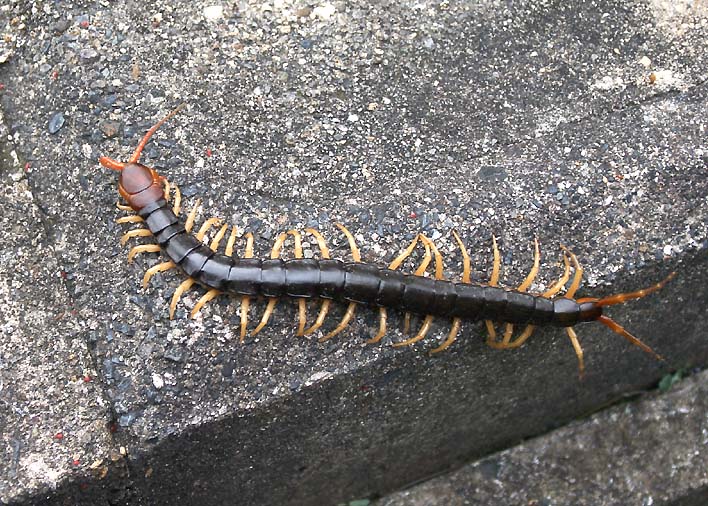
Mukade (scariest bugs I've ever seen...and dangerous too. See here).
Slow drivers, drivers who cut in front of you and slow down, one lane country roads
Indirectness
Disposal of Garbage, not knowing how to do it or where
Pollution, illegal dumping
He admitted that this session was half for venting and half for evaluating. I will admit it felt nice to vent. And he reminded us that regardless of where you live, there are going to be things you love and hate about a place. Next, we were asked to evaluate how we've changed over the past year, both good and bad. I hadn't really thought about it in an organized way before, and it was so cathartic to get it on paper:
I don't know what's good and what's bad, and maybe some of them aren't categorizable or maybe it doesn't matter, so I'll just list them:
-More resilient; it's difficult for anything to faze me these days because of experiences I've had.
-Flexible
-More relaxed, worry less, plan less (I have a funny story about this from my trip w/ K & A).
-Not afraid to take chances or face challenges
-Still not completely there, but I try think less about what people think of me
-Have learned how to keep stress and problems inside
-Have become more introverted at times (maybe this isn't bad...
-A little more sarcastic, a lot more judgmental, without even meaning to. (This, actually, is a change I don't like. I don't know what happened and I don't want to be this way, but thoughts pop into my head that I never thought I would have about other people, and I find sometimes, perhaps because of the language barrier, I assume things about people that may not necessarily be true. I don't know why or how this happened, but I'm working on stopping it).
-Not afraid to make a fool of myself anymore
-Appreciate my home country more and its values and amenities
-Not that I'm an alcoholic or anything, but I drink more frequently than I ever did in the States, partly because enkai and organized drinking parties are the way people bond here, particularly with coworkers, and going to as many of these of course puts you in a more favorable light.
Then we were told to think about why we came. And I guess I really thought about it for the first time, because for a long time I didn't know. Even before I left, I think the prospect of excitement and newness, and the adrenaline that came with it propelled me along. But I think if I had to narrow it down, I came to Japan because
1) I was looking for an adventure, to travel, to be challenged, to feel uncomfortable. There's something empowering in voluntarily putting myself in an unfamiliar situation and then working my way through it, hopefully to emerge victorious, meaning that I can become comfortable.
2) I wanted to be a world traveller. It's something that I daydream about, travelling to different countries. Not that there's a checklist or anything, but everyone that I know or have read about who has travelled has that other-wordly aura about them, and talk and pictures of places and things and experiences are something I covet. I love finding the differences and similarities between cultures and places. I guess also I don't want to be thought of as just another ignorant American, as we have unfortunately been stereotyped around the world. It doesn't help that our continent only has a couple of countries on it, versus, say, Europe, where there's a multitude of countries you can visit just by jumping in the car.
3) I'll admit the money was a big draw. Everyone says that I could easily make the same amount of money at an entry level job in the States, but why do that when I can get paid that same amount to go somewhere I'd never been before?
Now that's why I wanted to come here, but I never really thought about what I wanted to get out of it. That's a question for another day, I think. So far I am very content.
Anyway, to sum it up, the rest of the session we discussed different styles of dealing with problems, learning to identify how you function in those situations, the cycles of culture shock and how to deal with them, etc. Immensely helpful.
The other workshop I went to was equally enlightening. The presenter basically encouraged us not to be afraid to make fools of ourselves because the only way our Japanese is going to improve is by talking to people. There was a funny video involved, ridiculous role playing, and things of that sort, but whatever he said, I felt a billion times more pumped to learn more Japanese because he highlighted the fact that is accessible and necessary. I am surrounded by Japanese on a daily basis, I might as well use it. The idea is to pinpoint specific goals and then learn the vocabulary, practice and memorize, and use it over and over again. Such as:

Yes, that was an actual slide from the presentation. Obviously that slide is not necessarily an accurate representation of my own personal goals because a) I actually like squid and b) I have a fabulous man in my life, but you get the point about setting specific goals.
And with that the conference came to a close, and I think it was good I went. It was a nice refresher before Year #2 starts, and I definitely feel a lot more in tune with what I think and feel about where I am and what I'm doing. もういちねんかんよろしくおねがいします。


Slow drivers, drivers who cut in front of you and slow down, one lane country roads
Indirectness
Disposal of Garbage, not knowing how to do it or where
Pollution, illegal dumping
He admitted that this session was half for venting and half for evaluating. I will admit it felt nice to vent. And he reminded us that regardless of where you live, there are going to be things you love and hate about a place. Next, we were asked to evaluate how we've changed over the past year, both good and bad. I hadn't really thought about it in an organized way before, and it was so cathartic to get it on paper:
I don't know what's good and what's bad, and maybe some of them aren't categorizable or maybe it doesn't matter, so I'll just list them:
-More resilient; it's difficult for anything to faze me these days because of experiences I've had.
-Flexible
-More relaxed, worry less, plan less (I have a funny story about this from my trip w/ K & A).
-Not afraid to take chances or face challenges
-Still not completely there, but I try think less about what people think of me
-Have learned how to keep stress and problems inside
-Have become more introverted at times (maybe this isn't bad...
-A little more sarcastic, a lot more judgmental, without even meaning to. (This, actually, is a change I don't like. I don't know what happened and I don't want to be this way, but thoughts pop into my head that I never thought I would have about other people, and I find sometimes, perhaps because of the language barrier, I assume things about people that may not necessarily be true. I don't know why or how this happened, but I'm working on stopping it).
-Not afraid to make a fool of myself anymore
-Appreciate my home country more and its values and amenities
-Not that I'm an alcoholic or anything, but I drink more frequently than I ever did in the States, partly because enkai and organized drinking parties are the way people bond here, particularly with coworkers, and going to as many of these of course puts you in a more favorable light.
Then we were told to think about why we came. And I guess I really thought about it for the first time, because for a long time I didn't know. Even before I left, I think the prospect of excitement and newness, and the adrenaline that came with it propelled me along. But I think if I had to narrow it down, I came to Japan because
1) I was looking for an adventure, to travel, to be challenged, to feel uncomfortable. There's something empowering in voluntarily putting myself in an unfamiliar situation and then working my way through it, hopefully to emerge victorious, meaning that I can become comfortable.
2) I wanted to be a world traveller. It's something that I daydream about, travelling to different countries. Not that there's a checklist or anything, but everyone that I know or have read about who has travelled has that other-wordly aura about them, and talk and pictures of places and things and experiences are something I covet. I love finding the differences and similarities between cultures and places. I guess also I don't want to be thought of as just another ignorant American, as we have unfortunately been stereotyped around the world. It doesn't help that our continent only has a couple of countries on it, versus, say, Europe, where there's a multitude of countries you can visit just by jumping in the car.
3) I'll admit the money was a big draw. Everyone says that I could easily make the same amount of money at an entry level job in the States, but why do that when I can get paid that same amount to go somewhere I'd never been before?
Now that's why I wanted to come here, but I never really thought about what I wanted to get out of it. That's a question for another day, I think. So far I am very content.
Anyway, to sum it up, the rest of the session we discussed different styles of dealing with problems, learning to identify how you function in those situations, the cycles of culture shock and how to deal with them, etc. Immensely helpful.
The other workshop I went to was equally enlightening. The presenter basically encouraged us not to be afraid to make fools of ourselves because the only way our Japanese is going to improve is by talking to people. There was a funny video involved, ridiculous role playing, and things of that sort, but whatever he said, I felt a billion times more pumped to learn more Japanese because he highlighted the fact that is accessible and necessary. I am surrounded by Japanese on a daily basis, I might as well use it. The idea is to pinpoint specific goals and then learn the vocabulary, practice and memorize, and use it over and over again. Such as:

Yes, that was an actual slide from the presentation. Obviously that slide is not necessarily an accurate representation of my own personal goals because a) I actually like squid and b) I have a fabulous man in my life, but you get the point about setting specific goals.
And with that the conference came to a close, and I think it was good I went. It was a nice refresher before Year #2 starts, and I definitely feel a lot more in tune with what I think and feel about where I am and what I'm doing. もういちねんかんよろしくおねがいします。


3 comments:
great blog entry. i feel all caught up on what i missed during those three days!
Haha, thanks Sandaru. Yeah I missed you guys a lot, it was weird having to part ways like that. It would have been cool to go to Osaka with you guys, mmm tako-yaki!
*flails* i feel so awesome for being able to read and understand that last bit that was in japanese :D
KOBE BEEF *___* so expensive, but it looks yummy~
Post a Comment